

How Do Different Types Of Animals Survive Extreme Cold
How Animals Survive in Common cold Weather
Scientific discipline of the Common cold
The commonest question asked virtually polar animals in Antarctica and the Arctic is how practise they cope with the extreme common cold atmospheric condition that are found there?
The Problem
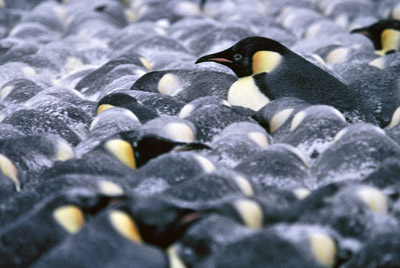
Emperor penguin huddle
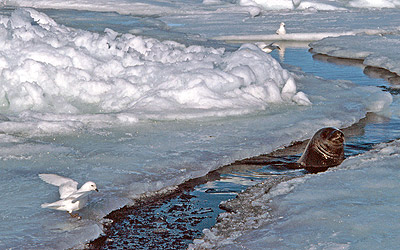
Snow petrels and a weddell seal share a tide fissure for line-fishing in
Air temperatures averaging below freezing over the yr (usually well below freezing) with a range in many places around -40°C to +10°C (-40°F to +50°F) and highs (very briefly and rarely) upwards to +22°C (+72°F) among rocks and moss banks.
Much of Antarctica is a cold largely featureless icy desert where in a higher place freezing temperatures are hardly reached if ever at all. The temperature of the Antarctic ocean that surrounds the continent varies from -2°C to +2°C (+28.4°F to +35.6°F) over the twelvemonth. Seawater freezes at -2°C (+28.4°F) and so it can't go any colder and notwithstanding be water.
Arctic and Antarctic birds and mammals such as penguins, whales, bears, foxes and seals - are warm blooded animals and they maintain similar internal body temperatures to warm blooded animals in whatsoever other climate zone - that is 35-42°C (95-107°F) depending on the species. They have to keep high torso temperatures to remain active. These animals are known as endotherms (endo-inside + therm-heat) equally they generate their rut internally. The polar regions' cold and wind mean that this heat tin very quickly exist lost leading to hypothermia (hypo-under).
Many (non polar) animals are ectotherms (ecto-outside) , which means that they generate and so little heat internally they are dependent on the external surroundings to warm them upwardly to a level where their trunk and enzymes part sufficiently well enough for an agile and functional life. Typically they raise their temperature by basking in the sun until they are warm enough to go agile. Reptiles and amphibians practice this while invertebrates are usually small enough to be able to warm up quickly to the ambient temperature from the air alone without basking in straight sunlight.
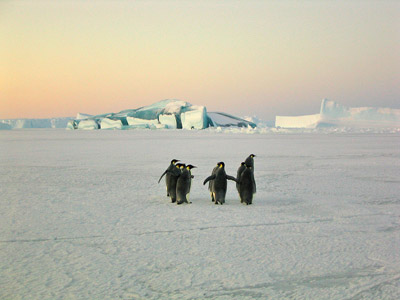
Emperor penguins breed in the depths of the Antarctic winter
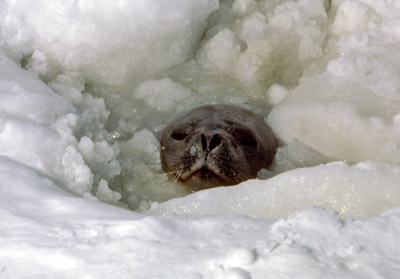
Weddell seals swim in h2o that is 2 degrees C either side of zero, the air temperature when they leave the body of water is ofttimes a lot colder
A big ectothermic Arctic or Antarctic land animate being would never get enough energy regularly enough from the surroundings to become sufficiently active once information technology had cooled. All polar state animals of any size therefore demand to be warm-blooded to exist active. The environment is so farthermost that the size limit in Antarctica for an ectotherm is well-nigh 13mm, the size of the largest fully terrestrial (country) animal in Antarctica. In other words any fauna larger than this would be unlikely to exist able to warm up plenty to become active before it started to get cold once more.
Migration - escape the cold
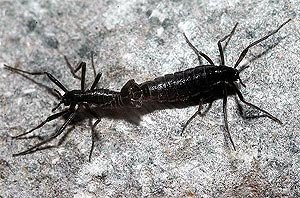 Antarctica is a land mass surrounded by a large very common cold ocean, and then different the Arctic, purely state-dwelling house animals cannot readily migrate in lodge to exit the continent in the long, harsh cold and dark months of the austral winter. The largest purely terrestrial animal institute in Antarctica is a flightless midge that grows no more than 13mm in length.
All other Antarctic animals are either smaller than this or migrate spending some of the year away from the deep south and the extreme common cold. They either swim or wing away - and back once more.
Ii examples of Antarctica's largest land brute - the 13mm long wingless midge Belgica antarctica has to stay where it is year round.
Why do animals go to Antarctica and the Arctic in the first place?
 An obvious question when seeing pictures of polar bears, penguins and seals amongst ice strewn oceans or snow and ice fields is why practise they go there in the first identify?
While it'due south all very picturesque and makes for nice photos and videos, it's hardly an inviting place to be, particularly if you don't take any shelter or external help (as animals don't).
The answer is that there is a huge seasonal supply of food. Due to upwellings of deep ocean water bringing high levels of nutrients to surface layers and long 24-hour interval length of upwardly to 24 hours light for months on end depending on the breadth that results in continuous photosynthesis. The southern ocean in particular is exceptionally productive.
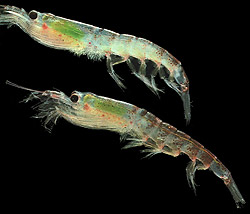
This productivity starts with phytoplankton, microscopic fast growing and reproducing plants that alive in the top layer of the ocean. These are eaten by zooplankton peculiarly Antarctic krill of various Euphausia species, peculiarly Euphausia superba (pictured).
There is literally millions of tonnes of potential food in the Southern ocean if you are able to take hold of it and procedure information technology efficiently. Big blue whales can catch and swallow 4 tonnes or more of krill a day for weeks on end in the summertime months, they are good at the take hold of and procedure thing.
Keeping warm in air and h2o
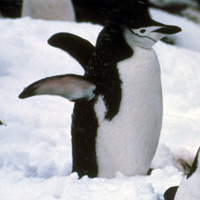
The pink blush on this chinstrap penguins' flipper is due to blood existence diverted to cool it down on this mean solar day when it is just higher up freezing signal.
H2o has a thermal conductivity around 25 times greater than air when still, with motion of the water and convection currents, this tin exist 50 to 100 times greater than air. This means that you lose heat much quicker in water than air, which you lot probably knew already.
There is a level called the "lower lethal temperature" which is the temperature at which an organism dies. This temperature in water has never been measured for mammals such as Antarctic seals and whales because it can't be. Even the coldest h2o (-2°C) doesn't issue in death meaning that these animals can live indefinitely in the coldest cold water without suffering from hypothermia.
The skin surface temperature of whales and seals is almost identical to the surrounding water, though at a depth of around 50mm beneath the peel, the temperature is the same as their core temperature. This is due to the insulating properties of a layer of blubber (fat) under the skin. Blab insulates in h2o, fur and feathers insulate in air.
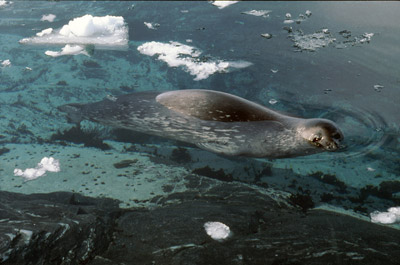 In the air a seals' skin temperature will often rise equally information technology needs to lose heat due to the air being less good at reducing temperature. The skin is well supplied with claret vessels that can shunt blood to the surface or deep within by the constriction or relaxation of tiny muscles that close or open up up flow through blood vessels.
Penguins, seals and whales have flippers and flukes (whales tails are called flukes) without blab that are poorly insulated though well supplied with blood vessels, these too can exist used to lose heat when needed. When it is necessary to retain oestrus, arteries surrounded past veins act every bit "counter electric current heat exchangers" to ensure that claret from the body heats claret returning from the flippers, and so retaining heat in the core and minimizing heat loss through the flipper or fluke.
Birds have similar counter-current estrus exchangers in their legs so they don't lose heat when swimming in frigid water. Like the seals and whales, the muscles required to operate these are deeper in the warm parts of the body and movements made via string-like tendons.
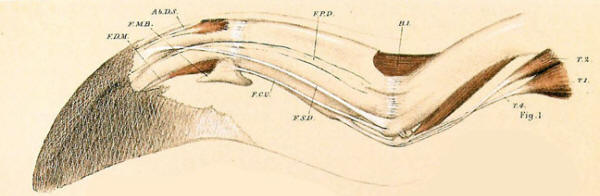
Rockhopper flipper showing how petty musculus (carmine-brown) there is.
Tendons attach to muscles that are deeper in the penguins body to prevent estrus loss
How warm blooded animals stay that way - endotherms and the common cold
Endotherm - An brute that generates heat from within past metabolic activity (warm blooded).
 Being able to generate your ain heat from inside and maintain a steady body temperature requires ii things:
- 1 - Taking enough energy in as food to generate the heat.
2 - Anatomical, physiological and behavioural adaptations to retain the heat generated.
These two are bound tightly together, unless y'all can raise and maintain your temperature, you cannot be active plenty to gather food, so there aren't whatever large cold blooded terrestrial animals in polar regions, once common cold they would never get warm enough over again.
How do endotherms (warm blooded animals) stay warm in extreme cold?
- All - Most importantly y'all need to be large to reduce the loss of rut from your skin, even small Antarctic animals are withal pretty big when compared to their more temperate climate relatives. At that place needs to be a depression surface area to volume ratio, lots of volume, little area.
- All - Extremities tend to be pocket-size to forbid undue heat loss (the surface surface area book ratio matter once more).
- All - You need to be well insulated, internally immediately under the skin with stored fat (blubber) and externally with fur (the best insulation of all, though not so adept when moisture) or feathers.
- All - Swallow lots of high energy like shooting fish in a barrel to assimilate nutrient to generate warmth from inside. All big animals (from the smallest birds upwards) in Antarctica are carnivores. Meat is a more full-bodied energy rich source of food than is institute matter that doesn't grow very well or very widely in Antarctica except as tiny plankton in the seas which requires extreme specialization to gather. Food supply is the main trouble, minor animals cannot consume enough to keep warm in extreme cold, they lose oestrus faster than they can replace information technology by releasing energy from food. Antarctic herbivores are the zooplankton, especially krill, these are modest cold blooded animals then convert the energy in phytoplankton into meat more effectively than if they were warm blooded.
- Some - Huddling together in large or small groups is a good way of getting protection from the wind and retaining warmth. The event is similar to the many huddled animals having the reduced surface surface area of a larger brute. due east.g. emperor penguins.
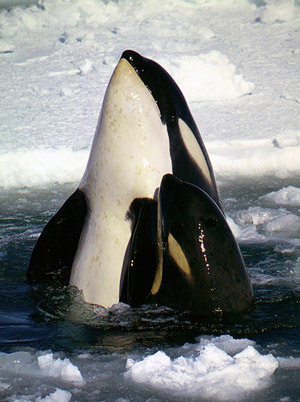
- Some - Whales and dolphins - never go out the sea, so fiddling exposure to extremes of air temperature, then migrating due north when the air temperature drops enough to freeze the body of water.
- Some - Seals - entering the sea at times of extremely common cold air temperatures and high winds, then migrating north when the air temperature drops enough to start to make the bounding main freeze.
- Some - countercurrent rut exchangers in flippers and feet means that these parts are kept at a lower temperature than the residual of the body to reduce oestrus loss, blood is cooled when it enters and warmed upwardly when it leaves the flipper or foot.
More well-nigh how penguins stay warm in the cold.
Ectotherms and the cold - being agile with common cold blood
Ectotherm - Animals that get heat from the outside (ecto - outside) surround, they cannot generate enough energy from internal metabolic processes to maintain a stable body temperature.
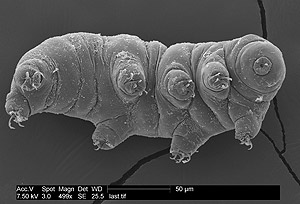 Ectotherms can warm upwards by basking (as almost reptiles exercise for example) their action is determined by the external temperature, when it gets cooler, they just slow down eventually becoming torpid (dormant or inactive).
There are no reptiles or amphibians in Antarctica and very, very few terrestrial invertebrates compared to the rest of the earth, information technology is the merely continent without ants for example. It'southward probably the only place where you have to actively get looking for creepy crawlies, and expect quite difficult too.
The largest truly land brute in Antarctica is a wingless fly about 13mm in length, this and other similar invertebrates are inactive for much of the time. When the sun comes out and warms them upwards (or rather their surroundings as they volition be hidden abroad somewhere), they become active for a few hours as long equally the temperature remains high enough, cooling down even below freezing betoken when it becomes colder. As they are so small, they tin can warm up quickly, if they were larger, they wouldn't have warmed upwards to agile temperature before the external temperature started to drop again.
These animals take lives of temperature dependent stop-get, the stop part can terminal for days, weeks or months, the become part can be just a few hours. They live in and amongst rocks, moss and other vegetation. Were they whatever larger or if they came out into the open, they would be like shooting fish in a barrel casualty for birds, especially if the temperature dropped causing them to irksome down while the warm blooded animals could remain active.
The Sea
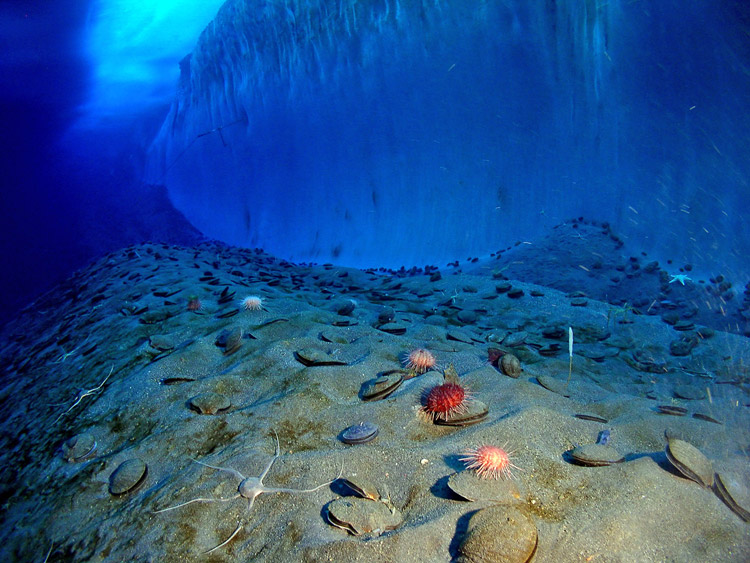
The Antarctic Ocean is cold but the temperature is very stable varying between -2°C and +2°C (+28.4°F - +35.6°F) over the year. It tin can go downwardly to nearly -2°C (really -i.9°C) before it freezes considering the dissolved salt reduces the freezing signal of sea-water.
The Southern ocean has been at this temperature for around 20 million years giving enough of time for plants and animals that live there to become adjusted to life in temperatures that would crusade nearly aquatic animals to simply boring downwards to a state of well-nigh torpidity (or suspended animation).
That they can practise this is downwards to having very specialized cold temperature adjusted enzyme systems, many Antarctic marine species are as agile at 0°C as their temperate counterparts are at 20°C. Cool the temperate species down and they almost terminate - notwithstanding warm the Antarctic species up and they soon start to endure, finding life at even +5°C difficult and most probably dying not long after this and way before reaching 20°C.
Many species of Antarctic fish have anti-freeze in their blood, not and then much against the temperature per-se as against touching ice which at low temperatures could cause a nucleation point making the ice spread through their cooled bodies. These anti-freezes are big glycoprotein molecules that surround whatever small ice crystals that may form, so preventing their spread throughout the animals tissues which would mean death. They likewise provide a tiny absorber for the end of abrupt ice crystals and then they are less likely to puncture cell membranes.
Interestingly merely fish that are likely to run across ice accept these anti-freezes, deeper living fish way below the level of floating ice don't take anti-freeze, some take a freezing indicate above that of the sea-water in which they live, and really should exist frozen solid. They spend their entire lives in a state of beingness "supercooled" that is, at a temperature that is below their freezing temperature. They can do this as they never come up into contact with ice crystals, ice is only found in the upper reaches. If these fish are brought to the surface where they tin come into contact with water ice, the ice will cause a nucleation betoken that spreads in their bodies causing instant freezing and death.
Words
There are many words used to describe the ability of animals to maintain their torso temperature. Some are infrequently used these days just all are still used at some time or other.
The bones distinction is between animals such as birds and mammals that maintain a stable core temperature of effectually 35-42°C irrespective of the ecology temperature and those whose temperature is variable, more closely reflecting the environmental temperature.
The reason that the nomenclature is non straightforward is that there are animals that decline to sit cleanly in one of the two apparently obvious categories. Some organisms conspicuously didn't read the rules and sometimes brand bits of themselves warmer than other $.25 irrespective of the ambience temperature or manage to maintain a stable internal temperature without necessarily generating that heat internally.
- Warm blooded - Animals that maintain a stable warm core temperature of effectually 35-42°C, the temperature is species dependent and oft very precise, it is 37°C in humans, slightly more or less will cause usa major problems.
Endotherm - Animals that generate rut from within by metabolic activity, normally this means that they can maintain a stable core temperature of around 35-42°C. The term can also apply some of the time to fish such as tuna that are able to maintain their active swimming muscles at 20°C or so above the temperature of the rest of their body by means of counter-electric current heat exchangers in their circulatory system, this keeps the pond muscles warm and so they work better and prevent estrus loss to the balance of the trunk.
Homeotherm - homo-same, therm-heat, an fauna that maintains a stable warm body temperature.
Cold blooded - Animals that have a torso temperature the same as the ecology temperature and are unable to warm it above this, not necessarily actually cold if the external temperature is high.
Ectotherm - Animals that cannot generate enough energy from internal metabolic processes to maintain a stable trunk temperature, nigh of the heat to warm them upwards comes from exterior of the animal.
Poikiliotherm - An animal whose internal temperature varies quite considerably (a little used term whatsoever more).
Heliotherm - An organism that warms itself up by basking in the direct rays of the sun.
Heterotherm - hetero-other, therm-heat, an animal that differs in its trunk temperature at dissimilar times.
It is possible that more than than one of these terms may apply to a particular brute at dissimilar times, which could exist daily or annually.
Picture credits, copyright pictures used by permission: Emperor penguins top of page - Warner Brothers / Killer whales - NOAA
Source: https://www.coolantarctica.com/Antarctica%20fact%20file/science/cold_all_animals.php
Posted by: gutierrezforood.blogspot.com
0 Response to "How Do Different Types Of Animals Survive Extreme Cold"
Post a Comment